Showing posts with label sketching. Show all posts
Saturday, April 16, 2016
surrounding colours


While Pedro searched for birds, I took out my fountain pen and watercolours to sketch a pretty little Kleinia Neriifolia. Heavy clouds hung above, teasing with a bit of sun, then returning to an inky grey. With the sketch complete, I wandered up the path a little to marvel at some lichen and the ribbons of colours that ran through the surrounding volcanic rock.


Wednesday, November 18, 2015
then, they came

Since it was my first time exhibiting at the Rendez-vous, I had no idea of what to expect, and judging by the queue of visitors that had already formed at the entrance to the Polydôme on Friday morning, I knew this experience was going to exceed anything I could have imagined. After sliding my sketchbooks into their case and making some last minute adjustments to the display, I swung by Solune's stand to say hello, and headed to the coffee bar for a cup.
Then they came.


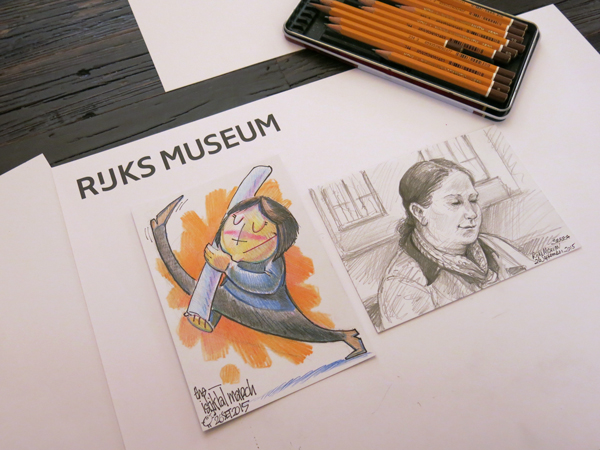
I don't know how many people I met, or how many portraits I drew on the fly— something that initially made me nervous to have so many eyes on me as I scribbled on sketchbooks and loose leafs of paper. My throat was dry, my cheeks hurt from all the smiling, and I became acutely aware of the different muscles used around the lips when speaking French— or at least trying to. Thank you to all you kind souls who patiently put up with my mangled version of your language!
If any of you happen read this, know that I had such a good time talking to each and every one of you. I enjoyed hearing about your trips to Turkey, your thoughts on art, and I loved drawing you. To the two girls whom I did not manage to capture in pencil so well, if you see this, write to me, and I will replace that sketch with a better one. To the young man pictured on the right below, I realise now that you were waiting to be drawn, and that you were too polite to tell those teenage girls that you were first. Write me, and I will draw you that portrait.


What fun!
Thursday, November 12, 2015
Sunday, May 25, 2014
the return to harran

The sun was blinding, casting sharp shadows, and the cloudless sky was cut by the glossy blue-black wings of barn swallows. The earth was ochre beneath my feet, and from the ruins of the ancient university of Harran, I could see the village's famed adobe houses with their beehive-shaped roofs. It seemed unchanged from when we visited last year— a comforting thought when living in a country where buildings, highways, and bridges seem to sprout up between blinks.


I wandered in between the few remaining beehive houses, relics of a once great Upper Mesopotamian city. The air was heavy with the smell of animal. In the shade of her doorway, a woman wrapped in a purple headscarf and robes of dusty velvet sat, leaning against the old wooden door, muttering. Her wrinkled face and hands were marked with faded bluish tattoos, the symbols too blurry to pick out as anything other than crosses. I asked if I could take her portrait, and with a wave of her hand, she consented. I tried asking what the tattoos signified, but her response was so garbled, I was unable to understand a word of it.
I snapped away under her piercing gaze, trying to use the opportunity to take as many photographs as possible in the hopes of coming away with something useful for future projects. As I began to put my camera away, she asked for some money. When I fumbled around in my wallet for some change, my fingers came up with nothing (and I didn't have any bills either). I sheepishly tried to explain that I was currently penniless, and was called a liar with unmistakeable clarity. I apologised and moved on, with a trail of insults behind me. I felt guilty.

I found shade in the courtyard of the "cultural center", a small adobe structure enclosed by a rectangular wall. The courtyard was arranged with low tables of embossed metal trays and Urfa's distinctive wooden stools, farming tools, and a table of scarves in various shades of violet, embroidered with white patterns. This is where Pedro and I had a çay and sketched last year— where I drew the portrait of Jamila, tore out it out of my sketchbook, and gave it to her.
I scanned the faces of the ladies who were relaxing in the shade of the awning, but Jamila was not among them. Suddenly, a woman too young for the depth of the lines between her brows, approached me with narrowed eyes.
"I know you!" she announced. "You came before, with your big, big man." Her hands reached into the air, trying to match Pedro's height.
My laughter brought out her own. I held up my sketchbook, and she nodded with a smile. I asked where Jamila was, and she explained that Jamila had moved to Istanbul in search of work. Jamila was her sister. She then pointed to one of the bee-hive roofs of the center, and told me that my drawing was on the wall inside.


I was deeply touched. I stood there grinning to myself as I remembered the encounter with Jamila— how she tried to keep a serious expression for her portrait, but could not control the corners of her mouth. I hope that wherever she is, she's still smiling.
Tuesday, May 21, 2013
göbeklitepe
Pedro and I left the hotel around seven. The light was pale and golden, and the sky seemed forgiving— though I suspected a drizzle was on its way. As we slowly drove through undulating fields of yellow and green grain, Crested Larks and shrikes went about their morning business, hunting for insects. Invisible partridges called out from somewhere in the wheat, and a little owl glared at us from a rock pile we passed.
We arrived at the entrance to Göbeklitepe at the agreed upon nine o' clock, but the rest of the group was nowhere to be found. After waiting for some time I called Ayşegül, who told me there had been complications, and that they would meet us at the site at around ten. Since we had an extra hour to ourselves, we decided to try and enter the site and get a head start on some sketching.
The actual temple site was a lot smaller than I had imagined, though no less amazing— I couldn't believe I was standing at the very spot I had read about, and the guy in the green shirt just on the other side was the Klaus Schmidt, the German archaeologist who first began excavations at Göbeklitepe in 1995. I wanted to bother him with all sorts of questions, but since he and his crew were working, I thought it best not to disturb him. I wondered if we were allowed to just walk right in, but no one stopped us. We each picked a T-shaped pillar and started to sketch.
As I mentioned in the previous post, Göbeklitepe is the site of a Neolithic sanctuary built by nomads in the region, around 10,000 BCE. The sanctuary is a series of circular arrangements of T-shaped pillars, which vary from 3 to 6 metres high. It is believed that the T-pillars are stylised representations of the human form, as some have reliefs of arms carved into them. What I found most intriguing were the beautifully rendered animals— foxes, boar, birds, and other animals were carefully carved into the faces of the pillars, some with great detail. Göbeklitepe is the oldest example of a religious site ever found, and its complexity is baffling.
While sketching, a man with an impressive beard and brow greeted me with a smile. His head was wrapped in a red checked scarf, and he donned a long black robe over his plaid shirt and shalwar pants. He wore a name tag that read "Mahmut Yildiz"— and it wasn't until I returned to Istanbul that I learned that Mahmut bey is the owner of the land upon which Göbeklitepe sits. He leased the land to Klaus, who is working with both the German Archaeological Institute and the Şanlıurfa Museum to unearth the sanctuary. Mahmut bey told me that the animal on the pillar I was drawing was a fox, then pointed out a small, faded rabbit shape, which I had neglected to notice and include in my sketch. I thanked him and pencilled it in, which pleased him.


At around half past ten the artists from karala(ma) arrived, along with Turkish archaeologist Mehmet Önal, and members of the university who were documenting the event. The artists took to drawing immediately, spreading out along the wooden walkway with tools and books in hand. I was impressed by the speed of their sketching— I was still on the one I had started an hour and a half ago!

Me, Pedro, and Orhan, one of the founders of karala(ma)
I felt so lucky— lucky to be sketching this monumental piece of human history, lucky to be drawing with a group of Turkish artists, lucky that it didn't rain. The stone pillars at Göbeklitepe were more impressive than I had imagined, so well preserved and readable. What did these animals mean? Why did nomadic people decide to haul and erect 40– 60 tonne stones here? I wish I could have stayed all day and sketched every single pillar, but eventually we had to move on. There was still a lot to see.


Labels:
Göbeklitepe,
karala(ma),
Neolithic,
Şanlıurfa,
sketching,
Turkey,
Urfa
Wednesday, October 31, 2012
sketching at the stupa

On a fine, bluish afternoon, Pedro, Pema and I took the art students to Boudhanath Stupa to sketch. For the older kids, this was a rare treat; to be able to leave school grounds to draw in public, and for the younger students, who had never done something like this before, it was utter excitement. Due to the high risk of child trafficking in Nepal, students are not allowed out of the school gates until their final year at SMD, so getting to explore the world outside their dorm room windows was a unique thrill. Their concentration was astounding— the wee ones drew for nearly two hours without losing focus or interest, and the older kids looked after them like hawks, offering advice and making sure the little artists were comfortable.


Just look at all those beautiful smiles!
How can I not keep returning?
Wednesday, October 10, 2012
sketching skulls
Just across the road from Gaida Lodge stands the tiny Wildlife Display and Information Centre, which houses an interesting collection of the region's animal skulls, hides, casts of footprints, as well as various beasts floating in formaldehyde. I loved it. For a mere thirty rupees, one could sit on the warm floor for two hours in front of a gharial skull and draw. While mentally disappearing into the many curved teeth of this unusual crocodilian (which I was fortunate to have seen in the flesh on my first day in Chitwan), the lady at the ticketing counter tiptoed over and sat down next to me. She didn't say much— she mostly smiled and watched me draw.
This was my meditation. No bells, no incense, no chanting. There was nothing in the world except me, the skull, my pencil, and the page of my sketchbook slowly filling— even the occasional mosquito or influx of Nepali and Indian tourists snapping photos of me with their phones could not move my eyes from skull or page. When the heat became too much to bear, and we had exhausted our fingers and eyes, we packed up.
"You come back tomorrow, no pay." The ticketing lady smiled.
"Oh yes, we'll come back!" I laughed, and thanked her profusely.
We couldn't make it the next day, but two days later, we were greeted by her warm smile. I already had my subject in mind, and sat down in front of a very yellowed one-horned rhino skull.


While I was lost in the lines of the rhino's nasal cavity, a small wave of Indian tourists took over the Centre. Suddenly, I felt a presence next to me on the floor, and in barely a second, a hand aggressively grabbed my chin, and shoved my face in the direction of a grinning older man with a camera.
I was ordered to smile.
His wife, wrapped in a colourful sari, had wanted a photo of herself with the foreign girl drawing on the floor. I was stunned— I've encountered some interesting reactions to my sketching in public before, but never have I been shoved or told to do anything— and she grabbed my face. I don't know about you, but for me, the face is an intimate part of the body, and mine is reserved for only a select few to touch with their hands. I was so shocked, so taken aback, that it only occurred to me after the flash blinded me, that this behaviour was uncalled for. What ever happened to asking for a photo? Once it was taken, they disappeared as quickly as they appeared, and I was left on the floor, without a word, my mouth agape.
Subscribe to:
Posts (Atom)