Wednesday, March 14, 2012
Tuesday, March 13, 2012
Monday, March 12, 2012
the goat and the pudding
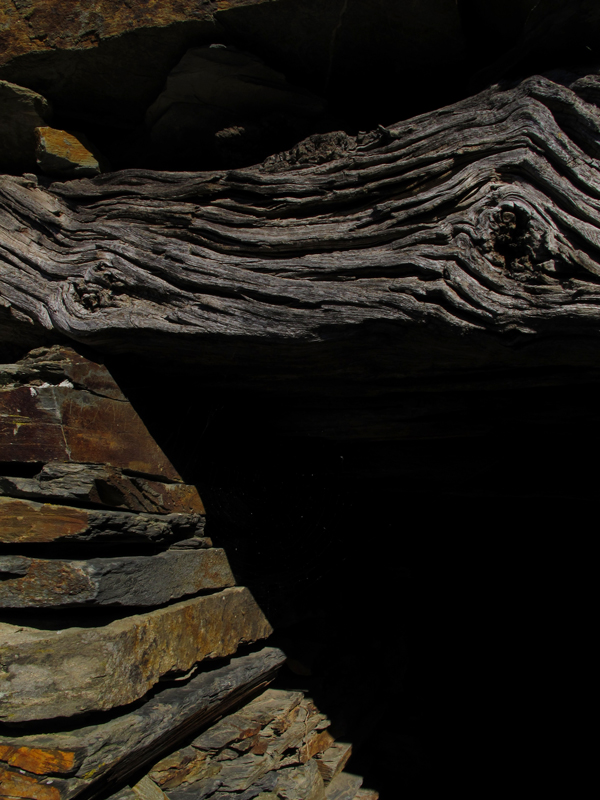
Nestled in the terraced valley of the Serra do Açor, lies a storybook village of schist and lines of blue. Piódão is a stark contrast to the other Portuguese villages I came across, which were generally a collection of white-walled boxy houses trimmed in yellow or cobalt.
The quiet had a thickness to it, occasionally broken by a voice— human, bird or goat. I was taken by the careful layers schist and slate, the reverence of cobalt, the little hand-made crosses of twigs nailed above doorways. Climbing the narrow passageways between the ancient houses, I felt that familiar longing in my stomach.
We were beckoned to a little restaurant by an emphatic and convincing man, where we became the sole diners. It was decided that I must try the chanfana, a hearty and hygge (I must use the Danish here, as there really isn't an English word to describe the feeling of this dish) clay-pot stew of goat meat and potatoes, a hint of mint, generous in olive oil. This stew was made for bread-dipping, and my goodness, the goat... It just melted.


And the best way to end such perfection? A coffee, some rice pudding, and a few good laughs.

Thursday, March 8, 2012
Tuesday, March 6, 2012
the spotting of a rare bird
Down the orange-tinted street, in the chilled night air, a voice, beautiful and haunting, halted our feet. A bundle of a woman, blind, with a donation box around her neck, was sitting on a stool on Rua Augusta, singing an aching song. In her hands was a simple triangle.
"It's Dona Rosa!"
"Who's Dona Rosa?" I asked.
This invisible lady, passed without notice, was none other than the famed Portuguese fado singer, Dona Rosa. Blinded by meningitis at the age of four, Dona Rosa lived in desperate poverty, attempting to make a living selling lottery tickets and magazines on the street. A friend gave her a triangle, and with it she took refuge from misery, singing to passersby, earning some extra money.
One day, an Austrian music producer happened across Dona Rosa, and invited her to sing at a music festival in Marrakesh, where she stunned audiences. Her unique voice, and the sincerity with which she sings, brings her to stages all over the world, accompanied by world-renowned musicians. Poland, Germany and Switzerland are soon to be graced with the presence of this incredible woman, and yet, here she was in front of our very eyes, singing as she had, years before. It was the spotting of a rare bird; an experience that stirred my soul.
"You can take Dona Rosa of the streets, but you can't take the streets out of Dona Rosa."
Perhaps returning to Rua Augusta is in some way comforting. Perhaps it is habit.
To whatever drives Dona Rosa to offer us her gift so humbly, I am grateful.
How lucky we are.

We jingled for change in our pockets, and with the clumsy clunk of the coins hitting the floor of her donation box, she paused ever so briefly, and said:
"Obrigada."
morality and sin

When I heard there was an original Hieronymus Bosch triptych, The Temptation of Saint Anthony, at Lisbon's Museu Nacional de Arte Antiga, I felt a flutter in my belly. Somewhere around the age of eight, my mother gave me a collection of large art books on all sorts of artists. My favourites by far were Vincent Van Gogh, Toulouse Lautrec, and John Singer Sargent— but there was this unpronounceable name which captivated my imagination with twisted bodies and impossible creatures, horrible, violent scenes painted elegantly with a sense of calm. I would easily spend what could have been hours, examining all the details of his work with a thrill.


Hieronymus Bosch was a Dutch painter in the 1400s, whose highly symbolic paintings often illustrate religious concepts of sin and morality. I never imagined I'd actually see one of his triptychs—to finally stand in front of his colourful panels, was just such an immense feeling, I am struggling to find the words to describe it.
Monday, March 5, 2012
lisbon in tiles

It got to the point during my wandering, where I was snapping photos of tiles nearly every ten steps. Lisbon is a city of unexpected colour combinations which somehow work harmoniously together— salmon and cerulean, saffron and bordeaux. Many of the city's buildings are tiled in mesmerizing patterns, which naturally pulled me to extract my camera from my bag, with oooohs and aahhhhhs.


Turkey has a rich ceramic and tile tradition, with gorgeous cobalts and floral motifs, that I can't help but wonder why there aren't more buildings covered in tiles. The fairly new Hacıosman metro station has massive panels of stunning Iznik tiles which feature the çintemani motif, a pattern of three circles, representing royalty and power. I imagine the cost of tiling entire metro stations would be astronomical, but it's just so lovely— and what a way to keep a tradition current.
Sunday, March 4, 2012
golden
Portugal has long held a grip on my imagination and curiosity. For some reason, I have always associated a golden yellow with the little country, and longed to see if this yellow was all in my head or a fact. I arrived one hour before Friday turned to Saturday, full of excitement, a warm feeling in my chest.
When morning rolled through the streets of Lisbon, I reluctantly unfolded my limbs and pulled myself from the warmth of the bed into the shower— the waking process feeling like honey.

A quick stop at the cute Pastéis de Belém for coffee and the tastiest little custard tart (well, two of them), provided me with the necessary fuel I required for a day of discovery. The plan was to spend a day and two nights in Lisbon, then to head into Portugal's centre, and possibly its beautiful South too. There was a lot to see in so little time; only a fine wandering would do.


Fortunately, I had the most charming guide.
And the light, it was ever so slightly golden.
Friday, February 24, 2012
a few delectable things
Chillies, garlic, basil, peanuts... Oh my goodness, how I was in gastronomical heaven in Vietnam. River eel with banana in coconut sauce. Delicate soups scented with star anise, and phở-- my most favourite soup in the world. Phở is a noodle soup that in my belief, cures all ills. When I lived in San Francisco, there was this little Vietnamese restaurant around the corner from my apartment, which made a marvellous phở. Anytime I felt down, sick, or concerned about something, this delicious and comforting soup would melt away anything wrong. To have it in Vietnam, was to have an even more perfect perfection-- and I enjoyed it for breakfast with dumplings every day.

Fish soups were particularly yummy, and in the Mekong Delta, I even ate... a rat! I am not sure why I did not photograph the rat, but I did sketch it. It was pretty good, and a little rabbity.


Subscribe to:
Posts (Atom)